

 Facebook
 X
X
 Pinterest
 Copy Link
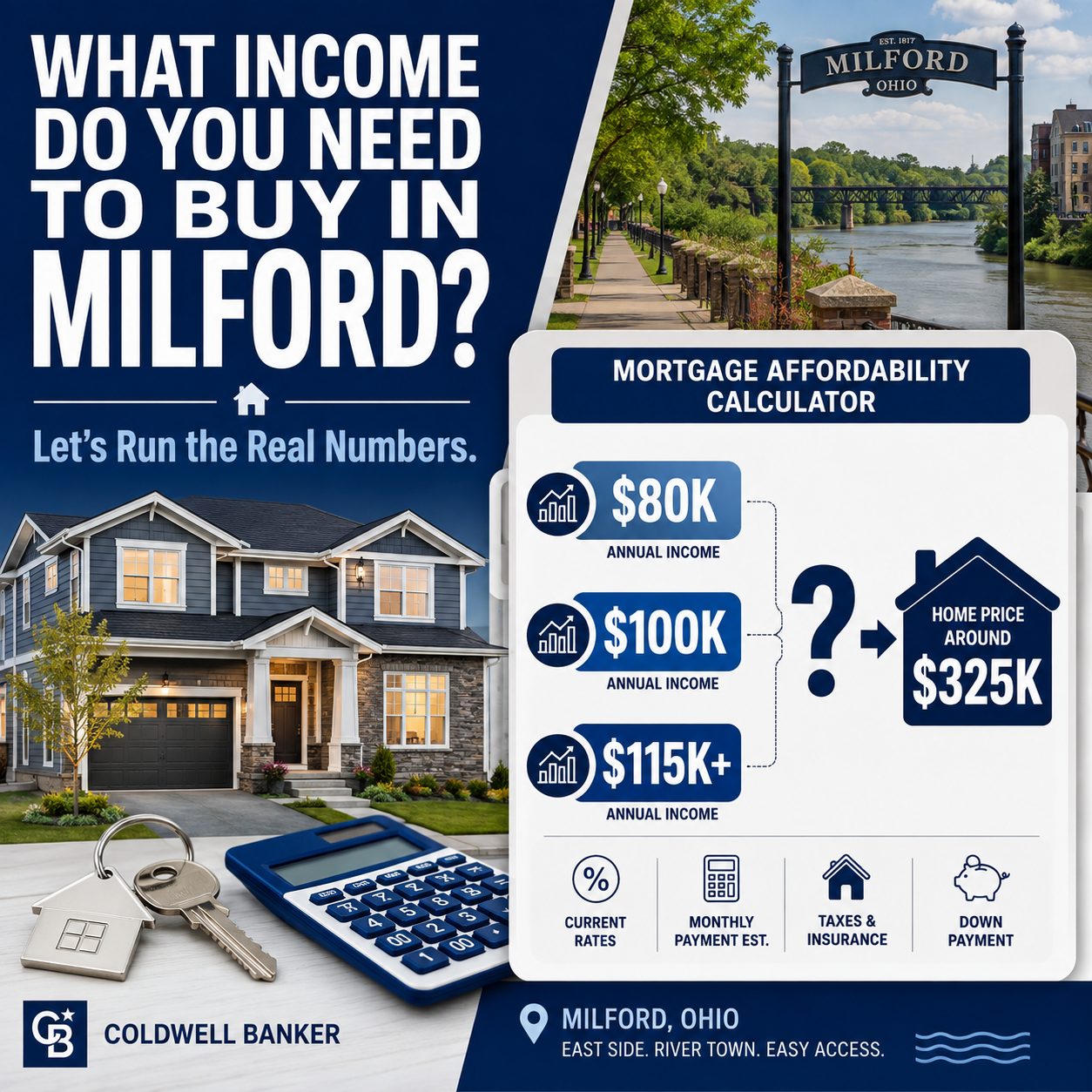
If you’ve been scrolling Zillow at 11pm wondering whether your paycheck can actually compete in this market, you’re not alone. The income needed to buy a home in Milford, Ohio depends heavily on your down payment, but for a typical median-priced home, most buyers need somewhere between $95,000 and $125,000 in household income to comfortably qualify. That range is wider than most people expect — and the difference almost always comes down to one number: your down payment.
Milford has quietly become one of the more competitive pockets of Clermont County, and buyers are showing up with real questions about affordability, not just curiosity. Let’s break down exactly what it takes.
⚡ Quick Answer
To buy a median-priced home in Milford, Ohio (around $355,000), you’ll typically need an annual household income between $95,000 and $127,000, depending on your down payment. A 20% down payment ($71,000) brings your required income closer to $95K–$104K. A 5% down payment pushes it toward $127K because of the larger loan and added PMI. Credit score, debt load, and property taxes also shift these numbers.
Why This Topic Matters Right Now
Milford’s housing market hasn’t slowed down the way some national headlines suggest. Homes here are still fielding multiple offers and moving in around 40–46 days on average. That pace means buyers who don’t know their real number going in tend to lose ground to buyers who do.
Meanwhile, mortgage rates have hovered in the mid-6% range through most of 2026, which changes the math significantly compared to the ultra-low-rate years. Understanding what you actually qualify for — before you fall in love with a listing — saves you time, disappointment, and wasted showings.
Key Trends & Data
Here’s where Milford stands right now:
- Median sale price: roughly $355,000–$360,000, depending on the data source and month
- Median price per square foot: around $204–$216
- Average days on market: 39–46 days
- Current 30-year fixed mortgage rate: approximately 6.7%
- Typical offer activity: homes are receiving multiple offers in many price ranges, particularly under $400K
That last point matters. Milford isn’t a market where you can take your time deciding — homes priced well and shown well are moving fast.
What Buyers Are Actually Thinking
Most buyers I talk to aren’t asking “can I afford Milford?” in the abstract — they’re asking “can I afford this specific payment, comfortably, without stress?” That’s the right question.
A lot of buyers also assume they need 20% down to buy anything. That’s simply not true anymore. Conventional loans with 5–10% down, along with FHA and VA options, are common paths into Milford right now — you just need to understand how that down payment level shifts your monthly number and your required income.
Popular Features & Lifestyle Considerations
Buyers coming into Milford are typically drawn to a mix of established neighborhoods with mature trees and larger lots, along with newer construction closer to the outer edges of town. Many are looking for proximity to the Little Miami Scenic Trail, the shops and restaurants of Historic Downtown Milford, and reasonable commuting access into Cincinnati.
Finished basements, updated kitchens, and larger lots tend to be the features that separate a “good” listing from one that sparks a bidding war.
Local Market Insights: Milford in Context
Milford sits inside Clermont County, bordered by communities like Miami Township, Union Township, and Loveland — each with slightly different price points and inventory levels. If Milford’s price range feels tight for your budget, it’s worth comparing against nearby Batavia or Amelia, where median prices tend to run lower.
📞 Not sure where your budget actually fits best? Schedule a free 30-minute strategy call and we’ll map out exactly which Clermont County communities match your number.
Financial & Lending Considerations
This is where the real math happens. Lenders typically look at your housing expense ratio (sometimes called the front-end DTI) — the percentage of your gross monthly income that goes toward your mortgage payment (principal, interest, taxes, insurance, and PMI if applicable).
Here‘s how that plays out on a $355,000 Milford home at today’s roughly 6.7% rate:
With 20% down ($71,000):
- Loan amount: ~$284,000
- Estimated monthly payment (PITI): ~$2,420
- Income needed: roughly $95,000–$104,000/year
With 10% down ($35,500):
- Loan amount: ~$319,500
- Estimated monthly payment (PITI, including PMI): ~$2,836
- Income needed: roughly $112,000–$122,000/year
With 5% down ($17,750):
- Loan amount: ~$337,250
- Estimated monthly payment (PITI, including PMI): ~$2,961
- Income needed: roughly $117,000–$127,000/year
Two things move these numbers around more than anything else: your credit score (which affects your rate) and your existing debt (which affects how much of your income lenders will count toward housing). This is exactly why a pre-approval conversation with a lender should happen before you start touring homes — not after.
Actionable Tips for Milford Buyers
- Get pre-approved before you shop. It tells you your real number, not a guess.
- Shop your rate. Even a 0.25% difference can shift your buying power meaningfully.
- Don’t assume you need 20% down. Many buyers qualify with far less.
- Factor in property taxes early. Clermont County rates vary by school district and township, so ask for the specific number on any home you’re considering.
- Build in a maintenance cushion. Lenders qualify you for the payment — they don’t account for the new roof in year six.
Pro REALTOR® Strategy 🎯
Here’s what most buyers overlook: the “median price” you see quoted online blends everything from starter homes to five-bedroom estates on acreage. That number tells you almost nothing about what your specific target home will actually cost.
The smarter move is pulling comps for homes that match your exact criteria — size, age, condition, neighborhood — so you know precisely what you’re competing against before you ever write an offer. That’s the difference between guessing and having a strategy.
Frequently Asked Questions
Do I need 20% down to buy a home in Milford, Ohio?
No. Many buyers purchase with 5–10% down through conventional loans, or with low or no down payment options through FHA and VA programs, depending on eligibility.
What credit score do I need to buy in Milford?
Conventional loans typically start around 620, though better rates usually kick in around 740+. FHA loans can allow lower scores with a larger down payment.
How much are property taxes in Milford, Ohio?
Rates vary by specific township and school district within Clermont County. It’s best to get the exact millage for any property you’re considering rather than relying on a citywide average.
Is Milford a buyer’s market or a seller’s market right now?
Current data shows homes moving quickly with multiple offers common, which points toward continued seller advantage in well-priced listings.
Should I wait for mortgage rates to drop before buying?
That depends on your personal timeline and financial goals. Rates have hovered in a fairly narrow range through 2026, and waiting also means competing against rising prices and potentially more buyers if rates do fall.
How much does PMI add to my monthly payment?
On a conventional loan with less than 20% down, PMI typically adds somewhere in the range of $150–$220/month on a Milford-sized loan, depending on your credit and down payment level.
What’s the difference between pre-qualified and pre-approved?
Pre-qualification is a quick estimate based on self-reported numbers. Pre-approval involves actual verification of your income, credit, and assets — and it’s what sellers take seriously in a competitive market like Milford.
Final Thoughts
Buying in Milford isn’t about hitting some universal income number — it’s about understanding exactly how your down payment, credit, and debt combine to shape your real buying power. Once you know that number, you can shop with confidence instead of guessing.
📲 Ready to find out exactly what you qualify for in Milford? Schedule your free consultation, check your home’s value if you’re selling first, or search current Clermont County listings to see what’s out there right now. You can also subscribe to the blog for more local market breakdowns like this one.
