

 Facebook
 X
X
 Pinterest
 Copy Link
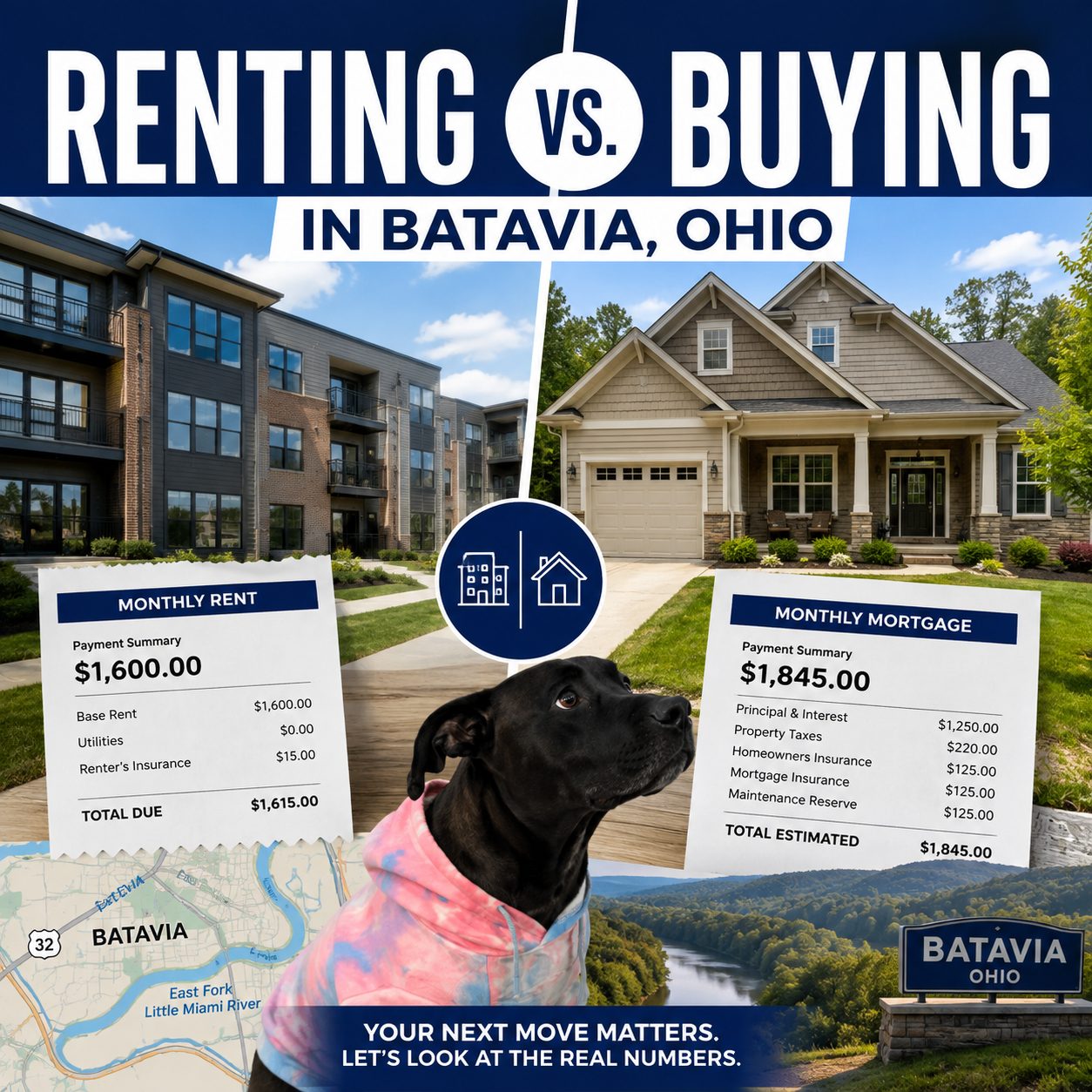
If you’re renting in Batavia right now and wondering whether you’re just throwing money away, you’re not alone. It’s the question I get more than almost any other from renters in Clermont County. 🏡
The honest answer isn’t “always buy” or “always rent” — it depends on your timeline, your finances, and what’s actually happening in the Batavia market today. Let’s break it down with real numbers instead of generic advice.
Quick Answer
In Batavia, Ohio, buying tends to build more long-term wealth than renting once you plan to stay 4+ years, since the median home lists around $358K while average rent runs $1,000–$1,700/month depending on size. Renting still makes sense if you need flexibility, have a shaky credit profile, or expect to relocate within a couple years. The right move comes down to your timeline, savings, and monthly budget — not a blanket rule.
Why This Topic Matters Right Now
Mortgage rates have settled into the mid-6% range for a 30-year fixed loan, and they’ve actually eased slightly over the past few weeks. That’s a meaningful shift from the rate anxiety of the past couple years, and it’s changing the math for a lot of renters who put buying on hold.
At the same time, rent in Batavia has climbed noticeably year over year. When your rent keeps rising and mortgage rates stop climbing, the gap between the two starts to close — and that’s exactly the environment we’re in heading into fall 2026.
Key Trends & Data: Batavia by the Numbers
Here’s where things actually stand in Batavia as of mid-2026:
- Median home list price: around $358K, roughly $182 per square foot
- Median days on market: about 58 days — not lightning fast, which means buyers still have some room to negotiate
- Average rent: roughly $1,000 for a one-bedroom up to $1,500–$1,700 for a two- or three-bedroom unit
- 30-year fixed mortgage rate: hovering in the mid-6% range, with 15-year rates closer to 6%
That gap matters. A renter paying $1,500/month for a two-bedroom is spending real money every year with nothing to show for it on the back end. A buyer at a similar payment is building equity with every mortgage payment, even if property taxes and insurance push the comparison closer.
What’s Actually Driving Renters to Consider Buying
Most of the renters I talk to aren’t chasing an investment. They’re chasing stability. Nobody enjoys getting a lease renewal notice with a $100–150 monthly rent increase attached to it.
Buying locks in your housing cost for the life of your mortgage (outside of taxes and insurance adjustments). That predictability is often the bigger motivator than any spreadsheet comparison. Beyond that, buyers in Batavia are typically looking for:
- Space for a growing family without a rent hike every 12 months
- A yard, garage, or storage that most rentals don’t offer
- The ability to make a house actually feel like theirs — paint, upgrades, pets, whatever they want
Popular Features & Lifestyle Trends in Batavia
Batavia draws buyers who want small-town pace without giving up access to Cincinnati. As the Clermont County seat, it has a walkable historic core, the county library’s main branch, and easy access to East Fork State Park for hiking and boating.
Buyers here tend to gravitate toward a mix of housing styles — traditional single-family homes closer to downtown, newer subdivisions on the outskirts, and acreage properties for buyers who want more breathing room. Commuting into Cincinnati is straightforward via Route 32, which keeps Batavia attractive for people working in the city but wanting more house for their money.
Local Market Insights
Batavia isn’t a fast-moving seller’s market like some of the closer-in East Side suburbs — that 58-day median days on market gives buyers a little breathing room compared to markets where homes go under contract in days. That said, well-priced homes in good condition still move quickly, especially anything under the median.
For sellers weighing whether to list, that same data point is useful context — realistic pricing still matters, but you’re not fighting the kind of frenzy we saw a couple years ago.
Financial & Lending Considerations
This is where a lot of “rent vs. buy” conversations go wrong — people compare rent to a mortgage payment and stop there. The real comparison needs to include:
- Down payment: Conventional loans typically want 5–20% down, but FHA loans can go as low as 3.5%
- PMI: If you put down less than 20%, expect private mortgage insurance added to your payment until you build equity
- Property taxes & insurance: These get bundled into most mortgage payments and vary by township
- Closing costs: Usually 2–5% of the purchase price, though some of this is negotiable with the seller
On a $358K home with 25% down, you’re looking at roughly $2,200/month including principal, interest, taxes, and insurance — noticeably more than average rent, but building equity instead of paying it to a landlord.
Not sure whether your numbers make buying realistic right now? That’s exactly what a quick conversation is for — schedule a free 30-minute call and we’ll run your actual numbers, not national averages.
Actionable Tips If You’re Weighing Rent vs. Buy
- Get pre-approved before you get emotionally attached to a number. Your actual buying power might surprise you either direction.
- Calculate your break-even timeline. If you’ll stay 3+ years, buying usually wins once you factor in equity growth.
- Don’t ignore maintenance costs. Budget 1–2% of the home’s value annually for repairs and upkeep — something renters never have to think about.
- Compare total monthly cost, not just the mortgage payment. Taxes, insurance, and PMI add up fast.
- Watch days-on-market data, not just list prices. It tells you how much negotiating room actually exists.
Pro REALTOR® Strategy
Here’s what most renters overlook: the biggest cost of waiting isn’t the mortgage rate — it’s the price. Home values in Batavia have continued climbing even as rate anxiety cooled off. Renters who wait for the “perfect rate” often end up paying more for the same house a year later because the price moved more than the rate did.
The move that actually saves money is getting pre-approved now, understanding your real numbers, and getting first access to listings before they hit the major search sites — not timing a rate you can’t control.
FAQ: Renting vs. Buying in Batavia, Ohio
Is it cheaper to rent or buy in Batavia right now?
Month to month, rent is usually lower than a mortgage payment. But over 4+ years, buying typically comes out ahead once you factor in equity growth and rising rent costs.
How much do I need to make to buy a home in Batavia?
Based on the current median list price of roughly $358K, most lenders want your total housing payment under 35% of gross monthly income — which puts the target household income in the mid-$70Ks with a standard down payment, though this varies by loan type and down payment size.
What credit score do I need to buy a house in Ohio?
Conventional loans typically want 620+, while FHA loans can work with scores as low as 580. Higher scores unlock better rates.
How long does it take to buy a home in Clermont County?
From pre-approval to closing, most buyers are looking at 30–45 days once you’re under contract, plus however long it takes to find the right home.
Is Batavia a good place to live?
Batavia offers small-town character as the Clermont County seat, with a walkable downtown, access to East Fork State Park, and a straightforward commute into Cincinnati via Route 32.
What’s the average rent in Batavia, Ohio?
Rent typically ranges from around $1,000/month for a one-bedroom up to $1,500–$1,700 for a two- or three-bedroom unit, depending on the property.
Are mortgage rates expected to drop further in 2026?
Most forecasts from sources like Freddie Mac project rates staying in the mid-6% range through the rest of 2026, with no major drop expected barring a significant economic shift.
The Bottom Line
Renting vs. buying in Batavia isn’t a one-size-fits-all answer — it comes down to how long you plan to stay, what you can comfortably afford monthly, and whether you’re ready to trade flexibility for equity. If your numbers make sense and you’re staying put for a few years, current conditions favor buyers more than they have in a while.
Curious where you actually stand? Schedule a free consultation and we’ll map out your real numbers together. Already own and wondering what your equity looks like? Find out what your home is worth. Ready to see what’s out there? Search Clermont County homes for sale or subscribe to the blog for more local market breakdowns like this one.
For more first-time buyer strategy, check out our guide to why buyers are moving to Batavia and our Clermont County market update series. And for national context on today’s rate environment, NAR’s housing data is a solid resource.
