

 Facebook
 X
 Pinterest
 Copy Link
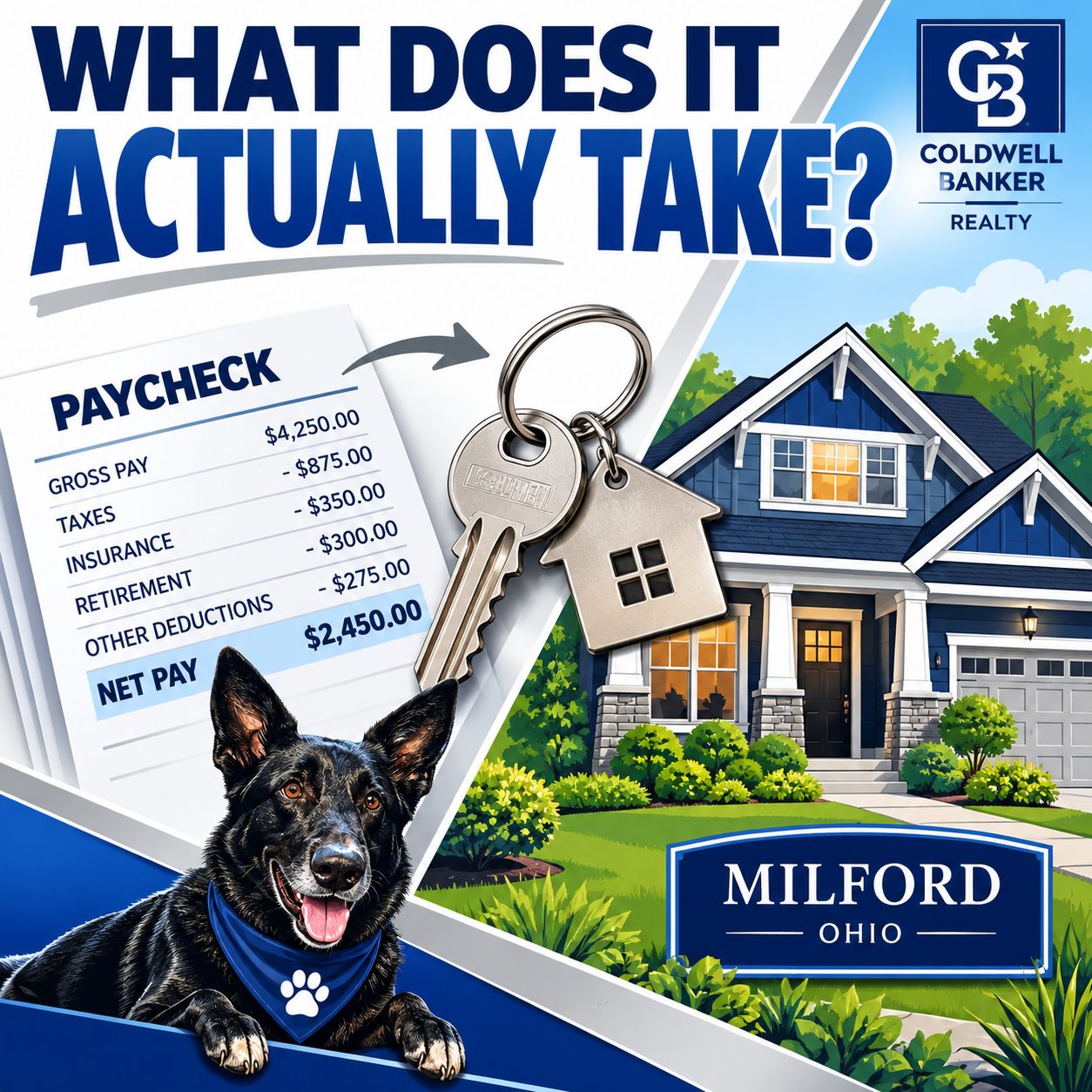
If you’ve typed “how much income do you need to buy a home in Milford Ohio” into Google at 11pm while scrolling listings, you’re not alone. 😅 It’s one of the most common questions I get from first-time buyers on Cincinnati’s East Side, and the honest answer is: it depends on a few numbers most people have never been shown together in one place.
So let’s actually walk through it — no jargon, no guessing, just the real math lenders use and what it looks like for someone buying in Milford today.
Quick Answer
Most lenders want your total monthly housing payment to stay around 28% of your gross monthly income, with total debt (including that payment) under roughly 36-43%, depending on the loan type. For a typically-priced Milford home, that often works out to a household income somewhere in the $65,000-$95,000 range, though your exact number depends on your down payment, credit, debt, and the loan program you use.
Why This Matters Right Now
Affordability has been the headline of the housing market for a couple of years now, and Milford is no exception. Buyers aren’t just asking “can I find a house I like” anymore — they’re asking “can I actually qualify for it, and should I wait for rates to move.”
That question matters more right now because inventory and mortgage rates are both moving targets. According to Freddie Mac, rates have bounced around in a fairly wide band over the past year, which means the same house can feel very different to your monthly budget depending on when you lock your rate. Knowing your real number now means you’re not scrambling to figure it out the moment you fall in love with a listing.
Key Trends & Data
Here’s what’s actually shaping affordability for East Side buyers heading into 2026:
- Housing payment-to-income ratios are the baseline lenders still use, even as loan programs have gotten more flexible than they were a few years ago.
- Debt-to-income (DTI) limits vary by loan type — conventional loans are typically stricter than FHA, which allows more breathing room for buyers carrying some debt.
- Down payment size moves your required income more than most people expect, since it directly changes your loan amount and your monthly principal and interest.
- Property taxes and insurance get folded into your payment calculation (lenders call this PITI), so two homes at the same price can require different incomes depending on the county and the age of the roof.
None of these numbers are fixed in stone — they’re guidelines lenders use as a starting point, and a good loan officer will walk you through where you actually land.
What’s Motivating Milford Buyers Right Now
Most of the first-time buyers I talk to in Milford aren’t chasing a trendy zip code — they’re looking for a manageable commute, a yard, and a payment that doesn’t eat their whole paycheck. Milford checks a lot of those boxes: it’s close to I-275, close to the Little Miami River and bike trail, and it still offers a mix of starter homes alongside larger updated properties.
That mix is exactly why the income question gets complicated — “a home in Milford” could mean very different numbers depending on size, age, and condition.
Popular Features & Lifestyle Trends
Buyers browsing Milford listings right now are consistently drawn to:
- Homes with updated kitchens or bathrooms (less to budget for after closing)
- Larger lots or walkability to Milford’s historic downtown and the bike trail
- Ranch-style layouts, especially from buyers who want one-level living
- Attached garages and basement storage — practical, not flashy
None of these features change who should or shouldn’t live in Milford — they’re just the practical things buyers mention wanting, and they do affect price, which affects the income conversation.
Local Market Insights
Milford sits right along the Little Miami Scenic Trail and the Milford Historic District, with easy access to US-50 and I-275 for a Cincinnati commute. Homes here run a wide range — from smaller starter properties to larger updated homes — which is part of why I always tell buyers not to trust a single “average price” number pulled from a national site. The real range matters more than the average.
👉 Want to see exactly what’s listed in Milford right now, with real prices attached to real homes? Browse current Milford listings under $400K — it’s the fastest way to see where your number actually lines up with what’s on the market today.
Financial & Lending Considerations
This is the part most people skip past, and it’s the part that actually answers the question.
Step 1: Start with the 28% rule. Take your gross monthly income (before taxes) and multiply by 0.28. That’s roughly the monthly housing payment most lenders will feel comfortable with, including principal, interest, taxes, and insurance.
Step 2: Check your total DTI. Add up all your monthly debt payments (car loan, student loans, credit cards) plus your estimated housing payment, then divide by your gross monthly income. Conventional loans often want this under 36-45%; FHA loans can allow more flexibility, sometimes up to 50% with strong compensating factors.
Step 3: Factor in your down payment. A buyer putting 3.5% down through an FHA loan needs a different income than a buyer putting 20% down, because the loan amount — and therefore the payment — is different, even on the identical house.
A simplified example (illustrative only, not a quote): on a home in the $300,000-$320,000 range with a modest down payment, many buyers land somewhere in the $70,000-$90,000 household income range once taxes, insurance, and current rates are factored in. Your actual number could be meaningfully higher or lower — this is exactly why step 4 matters.
Step 4: Get pre-approved, not just pre-qualified. A pre-qualification is a rough guess. A pre-approval is a lender actually pulling your credit and verifying income, and it’s the only way to know your real number instead of an estimate from a blog post (yes, including this one).
For more on current lending standards, the National Association of REALTORS® and Freddie Mac both publish regularly updated buyer resources worth bookmarking.
Actionable Tips for First-Time Milford Buyers
- Pull your credit report before you shop, so there are no surprises mid-process
- Get pre-approved before you fall in love with a specific listing
- Ask your lender to run numbers at a couple of different down payment levels
- Budget separately for closing costs — typically 2-5% of the purchase price in Ohio
- Don’t make large purchases or open new credit lines between pre-approval and closing
Pro REALTOR® Strategy (What Most Buyers Overlook)
Here’s the thing most first-time buyers miss: the “income you need” isn’t one fixed number — it shifts based on the specific home, the specific loan program, and your specific debt picture. Two buyers earning the exact same income can qualify for very different price points depending on their down payment and existing debt.
That’s why I always encourage buyers to have this conversation with a lender and an agent before they start seriously touring — so you’re shopping in your real range from day one instead of getting attached to something that was never going to work on paper.
FAQ: Buying a Home in Milford, Ohio
How much income do I need to buy a $300,000 house?
As a general guideline, many buyers land in the $70,000-$90,000 household income range for a home in this price point, depending on down payment, debt, and current rates — but a pre-approval is the only way to get your exact number.
What credit score do I need to buy a home in Milford?
It varies by loan program. FHA loans can allow lower credit score minimums than conventional loans, though a higher score typically unlocks better rates either way.
Do I need 20% down to buy a house in Ohio?
No. Many first-time buyers use loan programs that allow down payments as low as 3-3.5%, though a smaller down payment usually means mortgage insurance is added to your payment.
What is a good debt-to-income ratio for a mortgage?
Most conventional lenders prefer total DTI under roughly 36-45%, while FHA loans can allow more flexibility with strong compensating factors like savings or a longer work history.
Are there first-time buyer assistance programs in Ohio?
Yes — Ohio offers down payment assistance and first-time buyer programs through the state’s housing finance agency, and many lenders can tell you which ones you qualify for.
How much are closing costs in Ohio?
Closing costs typically run 2-5% of the purchase price, covering things like lender fees, title work, and prepaid taxes/insurance — your lender will give you an itemized estimate once you’re under contract.
What’s the price range for homes in Milford right now?
It varies widely by size, age, and condition — browsing current Milford listings is the most accurate way to see real numbers instead of a single average.
Conclusion: Know Your Number Before You Shop
The honest answer to “how much income do you need to buy a home in Milford” is: enough to comfortably cover roughly 28% of your gross monthly income in housing costs, with total debt staying inside your loan program’s limits — and the only way to know your real number is to run it with a lender.
If you’re thinking about buying in Milford or anywhere on the East Side, let’s map out your real numbers together before you start touring.
📞 Schedule a free 30-minute consultation
🏡 Search Clermont County homes
💰 Find out what your current home is worth (thinking of buying and selling?)
📖 Subscribe to the blog for more East Side buyer and seller guides
🧾 Grab the free First-Time Home Buyer Guide and the 30-Day Home Readiness Checklist to get organized before you talk to a lender
